Voix du Paysan: educating and informing citizens — a commitment to social and climate justice.
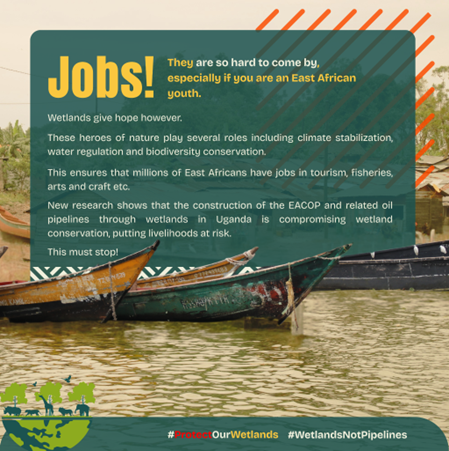
In East Africa, wetlands are not wastelands: they feed communities, provide protection and support livelihoods for thousands of young people. Yet the growing appetite for oil infrastructure threatens this natural capital.
Youth unemployment is one of East Africa’s deepest fault lines. In this struggle for jobs, wetlands have emerged as silent allies. Agriculture, fishing, livestock farming, ecotourism and small-scale commerce: these ecosystems sustain entire communities and create opportunities where formal economies struggle to provide employment. Destroying these environments therefore also means undermining the jobs and livelihoods they make possible.
Yet, in the name of oil and the promise of rapid development, these same landscapes are being crossed by infrastructure projects that can disrupt their fragile balance. EACOP, like other pipeline projects, raises a question that goes far beyond the energy debate: how many temporary jobs are enough to justify destroying sustainable livelihoods? A construction project may create employment for a few years; a well-preserved wetland can sustain a local economy for generations.
The challenge, therefore, is not to choose between jobs and the environment, but to reject this false dilemma. East Africa needs investment, certainly, but above all, it needs investment that does not sacrifice its ecological future on the altar of economic urgency. Protecting wetlands means investing in another form of prosperity: one that creates jobs without exhausting the land, water and natural resources on which young people depend.
At a time when governments are promising jobs to the younger generation, true boldness may lie in looking at these marshes, lakes and floodplains differently. They are not obstacles to development; they are already a form of natural infrastructure. Sacrificing them for a few kilometres of pipeline would amount to burning the very capital that could enable East Africa to build a more resilient, inclusive and sustainable economy.
Emmanuel Ndimwiza
Editor — Voix du Paysan